Speaker Interview: Jeremy Almaraz, Group Controls Manager, Sundt Construction
What is the biggest challenge faced by planning & scheduling professionals currently?
I believe the biggest challenge facing our profession is the growing gap between the increasing demands placed on schedulers and the industry's ability to develop them. Many schedulers enter the profession by learning software through field experience and necessity rather than learning the underlying planning and scheduling principles. That approach can work on smaller, less complex projects, but as responsibilities grow, those improvised methods become difficult to scale.
At the same time, experienced schedulers are in short supply. Too often organizations expect one scheduler to perform at a senior level without investing in mentoring or a senior/junior structure that develops the next generation. As a result, many new schedulers learn from project teams that have developed their own scheduling habits instead of learning industry best practices.
Meanwhile, owners are demanding higher-quality schedules, while AI, analytics, and modern technology are raising expectations for what scheduling data can deliver. That combination is forcing our profession to evolve rapidly, making training, standardization, and data quality more important than ever.
What are you personally speaking about at this year's conference, and why does it matter right now?
I'll be speaking on "Leveraging the Schedule as a Decision-Making Tool to Improve Risk Visibility, Forecasting & Project Performance." For many years, schedules were viewed primarily as contractual deliverables and reporting tools. Today, they are becoming strategic data sources that drive forecasting, analytics, and project decisions. That shift changes what it means to build and maintain a schedule.
Organizations are investing heavily in data warehouses, data lakes, AI, and business intelligence platforms. Those technologies only work when schedule data is structured consistently and governed properly. Data quality is much more than making sure the schedule reflects what's happening in the field. It also means placing information in standardized locations, using consistent coding structures, and building schedules that other systems can reliably integrate with other systems. When every project stores information differently, analytics become difficult or impossible. When schedules are built consistently, organizations can compare projects, identify trends, automate reporting, and leverage historical performance to improve forecasting. Instead of spending days exporting data to spreadsheets and manually creating reports, teams can generate meaningful insights in minutes. They also expose where the schedule no longer aligns with field reality, allowing project teams to identify issues much earlier.
Ultimately, this isn't just about technology. It's about transforming the schedule from a contractual deliverable into a trusted decision-making tool that supports better forecasting, earlier risk identification, and more informed project decisions.
What are you most looking forward to discussing or learning from at this year's conference?
One of the things I value most about this conference is the opportunity to hear how other companies are solving the same problems from completely different perspectives. As managers and schedulers, we make difficult decisions every day where competing priorities don't always align. Owners may require one thing, project teams may resist it, and practical constraints often force compromises that don't fit neatly into industry best practices. Seeing how other organizations navigate those same challenges is invaluable because it broadens your perspective. Sometimes another company has already solved a problem you're facing, or they've approached it in a way you hadn't considered.
I also enjoy seeing the latest advancements in scheduling technology. The pace of innovation is remarkable. Tools that once required days of manual effort—such as schedule quality reviews and analytics—can now be completed in minutes. AI-assisted schedule development, schedule validation software, predictive analytics, and modern reporting platforms are changing how we build, validate, and maintain schedules. What excites me most isn't the technology itself—it's seeing how these tools are reshaping the role of the scheduler. As automation continues to eliminate repetitive tasks, our value increasingly comes from interpreting data, understanding project risk, and helping organizations make better decisions.
As I was thinking through these questions, I realized they all point back to the same fundamental idea that has become the foundation of my presentation:
"AI isn't the revolution. Data quality is.
AI is simply exposing the consequences of decades of inconsistent scheduling practices. If your schedule isn't built for data, it isn't built for the future."
I think that idea captures where our industry is heading, and I'm looking forward to discussing it with everyone at the conference. Looking forward to seeing everyone in October!
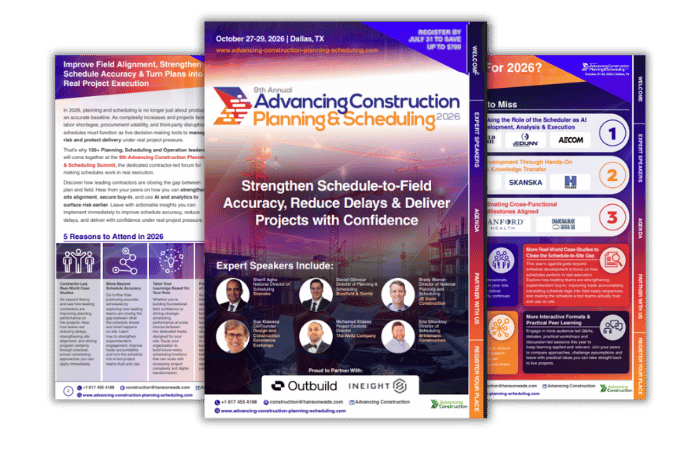
Explore the 2026 Event Guide
- 30+ Expert Speakers from leading GCs, clients & trades
- 3 Action-Packed Days dedicated to making schedules work in real execution
- 2 Tailored Pre-Conference Workshop Day Tracks
- Exclusive AI, Analytics, Project Controls & Field Execution Content
- Real-World Case Studies and Practical Strategies